Ordering shirts for a mission trip sounds like one of the simpler items on your prep list. It isn’t.
By the time you factor in your group size, trip timeline, budget constraints, color visibility in unpredictable environments, and the fact that some of your travelers are teenagers who will absolutely lose or ruin a shirt within 48 hours of arrival, all of a sudden your decision carries more weight than you originally thought.
This guide is specifically for the people doing the actual coordinating: youth pastors, church camp directors, mission team leaders, and the volunteers who somehow end up managing the logistics every year.
Here is how to think through the decision, what to look for in a vendor, and how the main options compare for groups with a fixed departure date and a tight budget to protect.
What Makes a Good Mission Trip Shirt

Before comparing vendors, it helps to get a clear idea of what you actually need. Mission trip shirts have a different job than most custom apparel, and the requirements that matter most aren’t always the ones vendors lead with.
High-Visibility Color for Group Identification
Whether you’re navigating an international airport, working a build site in a rural community, or serving in a busy urban environment, your team needs to be able to spot each other quickly.
Bright, consistent color is functional, not just aesthetic. This means you want a vendor whose color accuracy and ink saturation are reliable. What you see in the mockup should match what arrives.
Inconsistent dye lots or washed-out prints make your team harder to identify and undermine the cohesion you’re trying to create.
Durability for Physical Work Environments
Mission trips often involve physical labor: building, painting, hauling, outdoor service work in heat or humidity. The shirt needs to hold up through repeated wear and washing in conditions that may not be gentle.
Look for quality blank garments from brands like Gildan, Hanes, or Bella+Canvas. Also confirm that the print process (screen printing generally more durable than direct-to-garment for heavy-use scenarios) matches your expected wear conditions. Screen printing generally holds up to hundreds of washes, while DTG prints may fade sooner, especially on synthetic fabrics.
Budget Sensitivity Across Large Groups
Most mission trip groups operate on tight budgets, and shirts are frequently a line item that gets squeezed.
Remember that the math really matters here. At 40 shirts vs 80 shirts, your per-unit cost and total spend shift and you must understand whether your vendor’s pricing includes setup fees, shipping, and artwork adjustments or whether those appear as additions at checkout.
For nonprofits and church groups especially, surprises in the final invoice are disruptive and detrimental.
Turnaround That Fits Trip Prep Timelines
Mission trip logistics involve a lot of moving pieces, and shirt orders often land later in the prep cycle than they should.
If your departure date shifts, which happens more often than anyone plans for, you need a vendor with flexible rush options. The standard 10-day production window would not work in this case.
Ask upfront whether the vendor guarantees delivery dates or estimates them, and what rush tiers are available if your timeline compresses.
Two Ordering Models: Bulk vs. Crowdfunding Campaign
Most mission trip groups will use one of two approaches to get shirts ordered, and the right choice depends on your group structure and budget situation.
Bulk Order (Best for Most Mission Teams)
You collect sizes, place a single order, receive shirts in bulk, and distribute them before departure. This is the right model for most mission trips because it gives you control over timing, color consistency, and cost per shirt.
It requires knowing your roster before ordering and having someone manage the size collection process, but for organized groups with a confirmed team list, it can be the most efficient path.
Minimum orders at most bulk printers start 6-12 pieces, with pricing that improves substantially at 24, 48, and 72+ pieces. Most mission teams fall in the 20-80 shirt range, which is a sweet spot for pricing at vendors who specialize in this segment.
Crowdfunding/Campaign Model (Best for Open-Enrollment or Fundraising)
Platforms like Bonfire and Fund the Nations let you set up a campaign where team members or supporters buy shirts individually, the platform handles printing and individual shipping, and your organization collects a portion of each sale.
This model eliminates inventory risk and works well when you’re not sure how many people will participate, or when shirt sales are part of your fundraising strategy.
The tradeoff: you have less control over timing (shirts ship to individuals, not as a group), per-shirt margin is lower, and you can’t guarantee everyone receives their shirt before departure. For groups with a fixed team roster and departure date, a bulk order almost always makes more sense.
How Popular Custom T-Shirt Vendors Compare
1. BlueCotton
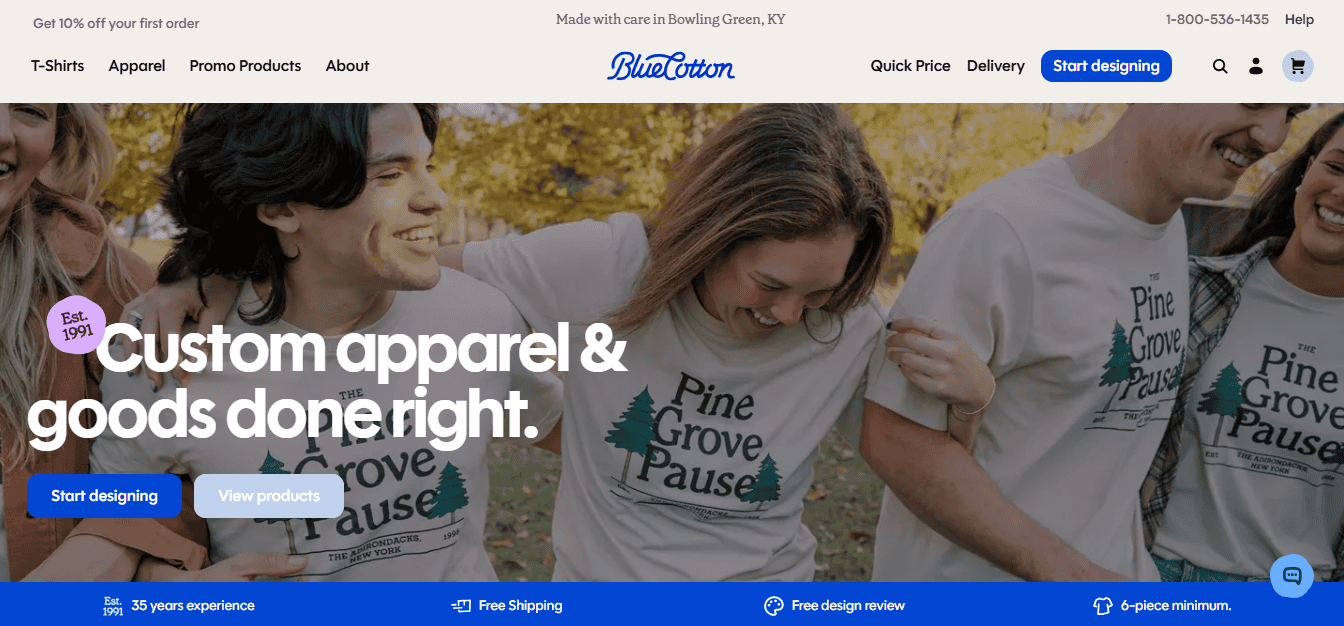
BlueCotton’s printing, quality inspection, packing, and shipping all happen out of a single 50,000 square foot facility in Bowling Green, Kentucky rather than through an outside production partner.
On timing, they offer 1- day, 3-day, and 5-day Rush tiers in addition to standard production, with guaranteed delivery dates on every order.
Every order goes through a nine-step quality inspection before shipping, and minimum order size starts at six pieces, scaling up to several thousand for larger programs.
Best for: Bulk orders with fixed non-negotiable departure dates, groups that want the fastest available rush tier (1- day) if a trip deadline compresses significantly, and church nonprofit buyers who want to reach a live person at the same facility as handling production.
Watch for: Their catalog and design specialty lean more general-purpose than ministry-specific, so if matching ministry language and context matters as much as speed, weigh that against what Ministry Gear offers.
2. Ministry Gear
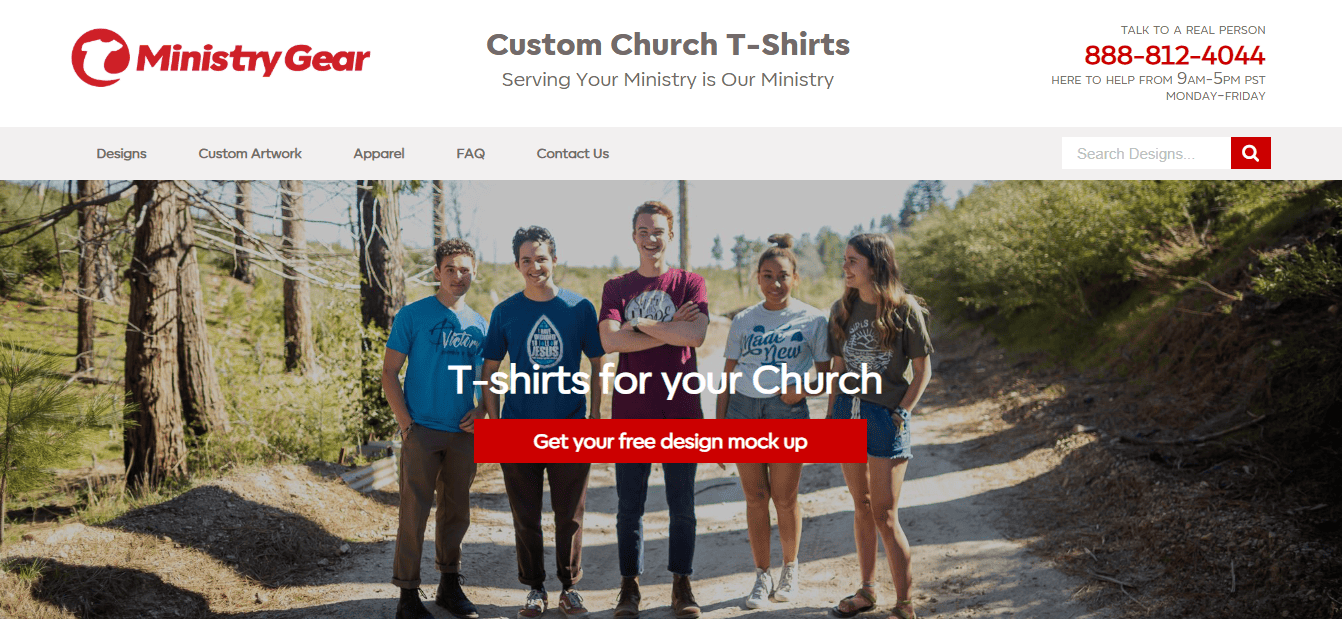
Ministry Gear builds its pricing and process specifically around churches, and that shows up in concrete terms.
Design services are free with every order, along with free shipping, and the company states there are no hidden fees. On timing, standard Ground Service is guaranteed to arrive within 14 days, with a rush option guaranteed within 8 days, and “Miracle Delivery” tier guaranteed within 3 to 6 days.
All orders are shipped within the 48 contiguous states. They also back this with the stated guarantee: if shirts arrive flawed or later than promised, the company says it will make it right.
That combination of a published guarantee and multiple delivery speed tiers gives mission trip organizers something concrete to hold them to. This is a point in their favor if your departure date is fixed, but you don’t need the absolute fastest turnaround available.
Best for: Church-specific designs groups that want a vendor that already understands ministry language and context, teams who want a written delivery guarantee at standard speed.
Watch for: Their fastest tier (3-6 days) is a bit slower than the fastest option from some competitors, so if you’re inside a one- week window, confirm Miracle Delivery can still make your date before committing.
3. Custom Ink
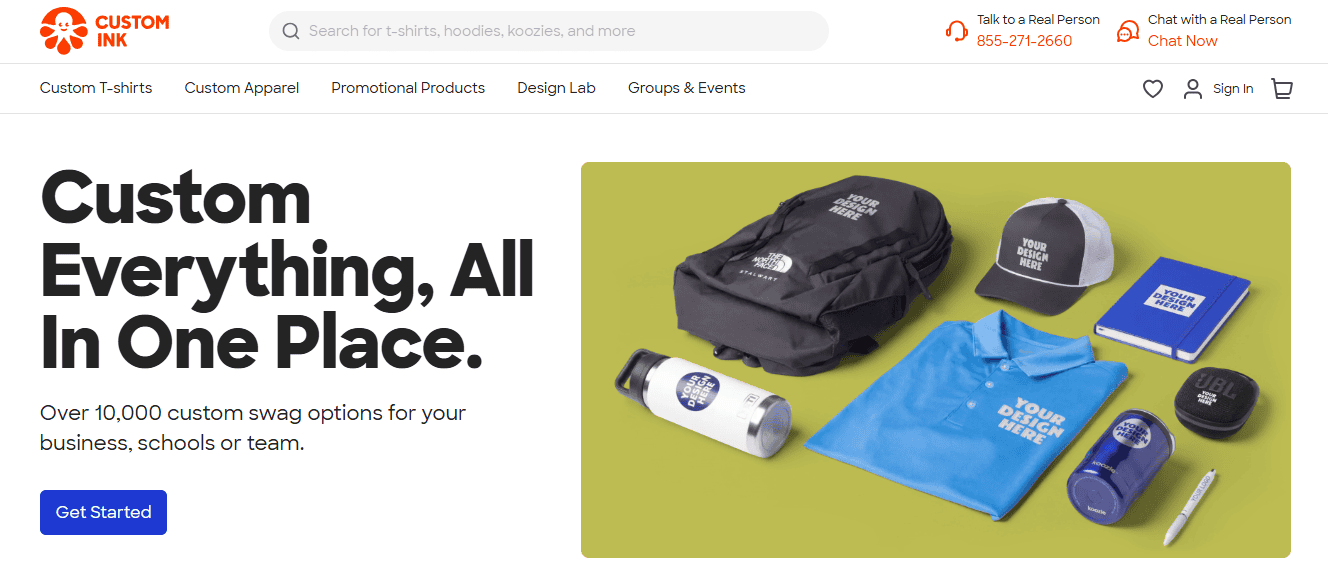
Custom Ink’s pricing structure is transparent: the price you see is the price you pay, with no hidden add-ons once you’ve configured your order.
Most products have no minimum order requirement, and per-piece pricing decreases automatically with quantity, whether you are ordering 25 pieces or 2,500. On timing, standard delivery is estimated at two weeks, Rush Delivery brings that down to one week for an additional 15% of the order cost, and Super Rush gets the items to your door in three business days for an additional 30%.
The thing worth understanding structurally is how that speed and breadth is delivered. Custom Ink has shifted a significant share of its production from in-house screen printing to a network of outside digital print fulfillers.
This is in part how they support such a wide product catalog and broad delivery options. For a trip with a flexible prep window, this rarely caused friction. For a fixed departure date with zero room to adjust, ask directly whether your specific rush tier comes with a guaranteed date or an estimated one for your region.
Best for: Groups comfortable with a well-known vendor, teams who want fast rush tiers with clear added costs, trips with a one-week cushion built in
Watch for: Confirm whether your chosen delivery tier is a guarantee or an estimate for your specific order and location, especially under Super Rush
4. Bonfire
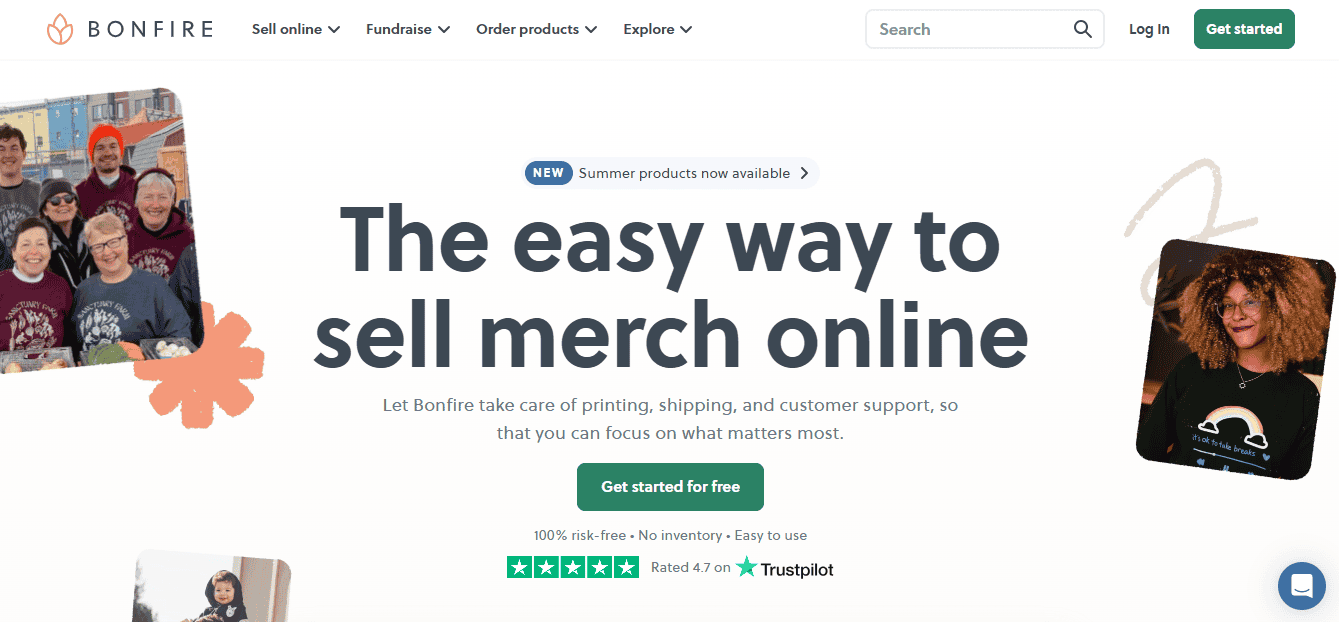
Bonfire has no minimum order requirement, and bulk orders receive discounted pricing with no upcharges for sizes 2XL and up. Setting up a campaign is free, and selling though a Bonfire campaign is also 100% free, so all of the profits go directly to the organizer.
The Pricing is built from a base cost covering manufacturing and printing, and that base drops as quantity increases, so per-shirt saving improves the more you sell. Once a campaign closes, shirts typically arrive within 10 to 14 business days and payment via PayPal is issued 1 to 3 business days after the campaign ends.
The tradeoff here is structural. Since shirts can ship directly to each individual buyer rather that arriving as on bulk shipment, there is no single guaranteed delivery date for your whole team. If your trip roster is locked and everyone needs to be wearing the same shirt by departure day, that timing flexibility works against you rather than for you,
Best for: Fundraising campaigns, open-enrollment trips where the roster isn’t fixed, or situations where minimizing financial risk matters more than coordinated group timing.
Watch for: No single guaranteed delivery date for a group shipment, and the 7-14 business day production and shipping window starts after your campaign closes, not when you place and order.
Five Design Tips for Mission Trip Shirts
A few practical notes that come up repeatedly:
- Keep the color bold and consistent. Bright solid colors work better for group identification. They’re also easier and cheaper to print cleanly.
- Limit your ink colors. A two or three-color print looks clean, photographs well, and costs less per shirt than a full-color design.
- Order a size buffer. A 5-10% buffer on your most common sizes (usually M, L, XL) gives you flexibility without dramatically inflating cost.
- Get your artwork ready early. If your church or organization has a logo, make sure you have a high-resolution version (300 DPI or higher, vector preferred) before you contact a vendor.
- Confirm whether your vendor includes design services. Some do; some charge separately. Ask directly, especially if you’re submitting a hand-drawn logo or a low-resolution file that needs clean up before it’s print-ready.

A Timeline Framework for Mission Trip T-Shirt Orders
Work backward from your departure date:
- 8-10 Weeks Out: Finalize design concept and group size estimate. This is also when to request black garment samples if you want to check fabric and fit before committing.
- 6 Weeks Out: Collect final sizes from team members and place your order. This gives you a comfortable standard production window with no rush required.
- 3-4 Weeks Out: Still manageable with most vendors, but confirm production timelines explicitly and get a guaranteed delivery date in writing.
- 2 Weeks or Less: You’re in rush territory. Not every vendor can handle this, so confirm rush availability and cost before assuming it is an option.
- 5-7 Days Before Departure: Shirts should be in hand by this point at the latest, with time to sort by size, label bags, and distribute before your team disperses for final
Final Takeaways: Choosing the Right Custom T-Shirt Vendor
Ordering custom t-shirts for a mission trip comes down to a few key decisions: choosing between a bulk order and crowdfunding campaign, locking in a vendor that can guarantee your delivery date, and keeping your design simple enough to print cleanly and photograph well in the field.
Before you place your order, run through this quick checklist:
- Confirm your model. bulk order for fixed roster and departure date, or crown funding campaign like Bonfire if your group is still growing or shirts double as a fundraiser.
- Get a guaranteed date, not just an estimate. Ask every vendor directly how they handle delivery commitments, and compare their rush options against your actual timeline.
- Keep the design simple. Bold, solid colors with two or three ink colors print faster, cost less, and hold up better for group identification.
- Build in a size and time buffer. A 5 to 10% size cushion and a five to seven day arrival window before departure protect you from last-minute surprises.
The right vendor for your trip depends on your roster, your budget, and how much flexibility your timeline has. Whether that’s Bonfire, Ministry Gear, Custom Ink, or BlueCotton, the goal is the same: shirts that arrive on time, look great, and let your team focus on the trip itself instead of a logistics scramble.