If you’ve started researching the new federal Education Freedom Tax Credit (EFTC), you’ve probably run into an unfamiliar acronym over and over: SGO. It’s the piece of the puzzle that determines whether your donation generates a tax credit, so it’s worth understanding before you give a dollar.
Here’s the plain-language version of what an SGO is, how the 90/10 rule keeps it accountable, who qualifies on both sides of the transaction, and what to expect as this program comes online over the next year.
What Is an SGO?

A Scholarship Granting Organization (SGO) is a 501(c)(3) nonprofit whose job is to sit between donors and students. Donors give; the SGO collects, verifies, and distributes those funds as K-12 scholarships to eligible families. It’s the entity the federal government checks before a donor’s contribution counts toward a tax credit.
Here’s the thing though, not every education-focused nonprofit is an SGO. A school isn’t automatically one. A general education charity isn’t automatically one. To qualify, an organization has to meet specific federal criteria, register in a state that has opted into the program, and operate under rules designed to keep the money flowing toward its intended purpose: scholarships for students, not overhead or unrelated programming.
This isn’t a brand-new invention. Individual states have run their own SGO-style tax credit scholarship programs for years, some going back well over a decade, so the basic mechanics (donor gives, SGO verifies and distributes, family receives a scholarship) aren’t experimental. What’s new is that this structure is now being scaled to a federal tax credit, meaning donors can fund scholarships in any state that opts in, rather than being confined to whichever individual states happened to pass their own version.
One example is AFC Scholarship Fund, a qualified SGO affiliated with the American Federation for Children, now gearing up to operate at a national scale. Its role is to handle the compliance, verification, and distribution work so that a donor’s contribution reliably becomes a student’s scholarship.
The 90/10 Rule, Explained
This is the process that keeps SGOs honest, and it’s simpler than it sounds.
Federal law requires that an SGO allocate at least 90 percent of the revenue it takes in toward scholarships for eligible students. That leaves a maximum of 10 percent for administrative costs, such as staffing, compliance infrastructure, verification systems, and reporting.
In other words, if an SGO collects $1,000,000 in a given year, $900,000 of that has to go out the door as scholarships. The remaining $100,000 is the ceiling, not a target, for everything else the organization needs to run: payroll for the staff who verify family income, the systems that track fund segregation, the reporting required to stay on a state’s certified list, and general administration. An SGO that spends less than 10 percent on overhead and more than 90 percent on scholarships is still fully compliant. It’s the reverse that’s not allowed.
A few things about how the rule works in practice:
- Contributions can’t be earmarked for a specific student. Donors don’t get to hand-pick a recipient; the SGO applies its own eligibility and awarding process across its full pool of qualified students. This is a deliberate design choice. It keeps scholarship decisions tied to documented need and eligibility criteria rather than personal relationships or favoritism, and it’s part of why the program is structured as a credit for giving to an organization rather than a deduction for a direct gift to a family.
- Board members and major donors are excluded from receiving scholarships themselves, which closes off an obvious conflict-of-interest loophole. Someone who sits on an SGO’s board, or who gives substantially to it, cannot turn around and have their own child, grandchild, or other dependent receive a scholarship funded by that same organization.
- There’s a distribution requirement: scholarship dollars have to reach students across a range of schools, not concentrate in one institution tied to the SGO’s founders or leadership. This keeps an SGO from functioning as a single school’s private funding arm.
Regulators have previewed the idea of a “safe harbor” measurement for organizations whose core activity is scholarship-granting, which would simplify how SGOs demonstrate compliance. That guidance, like several other pieces of the program, is still being finalized by the Treasury Department.
Final rules on exactly how the 90/10 calculation gets measured, audited, and reported are expected as part of the broader regulatory package tied to the credit’s January 1, 2027 start date.
The upshot for a donor: the 90/10 rule is the reason a contribution to a qualified SGO isn’t just a donation in spirit. It’s a structurally accountable one, backed by a specific, enforceable spending floor rather than a vague mission statement about helping students.
Who Qualifies: Donors
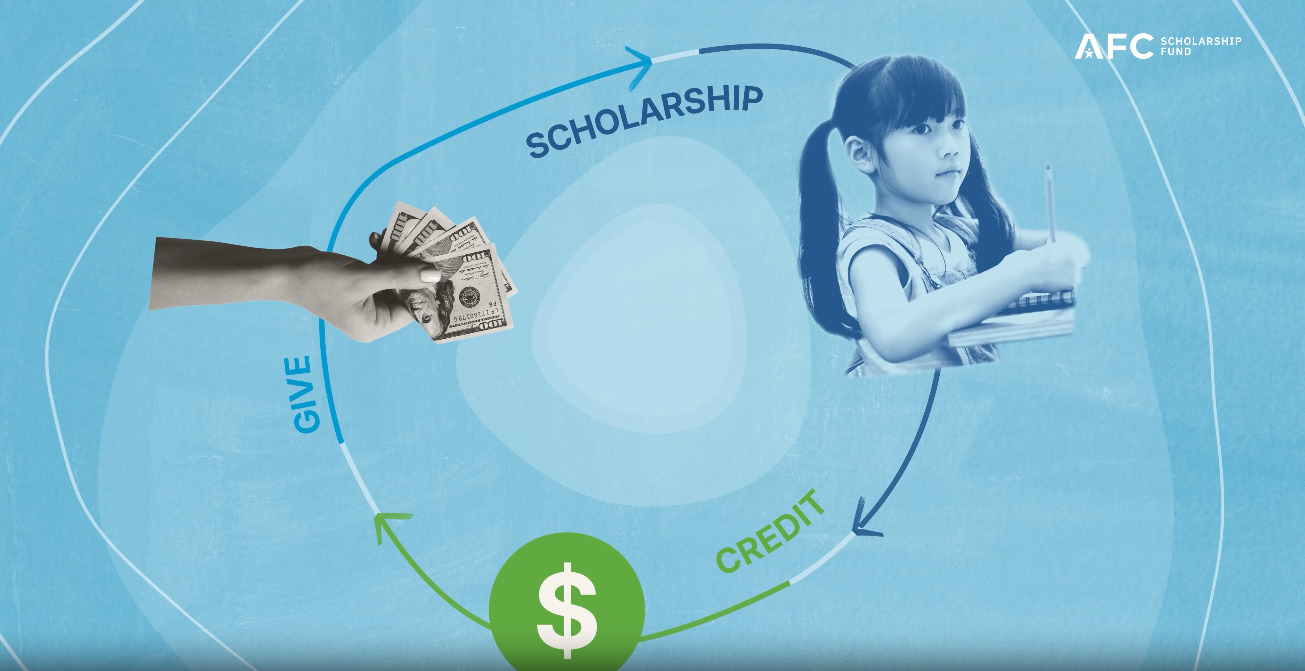
Starting January 1, 2027, an individual who makes a qualifying cash contribution to a qualified SGO can claim a nonrefundable, dollar-for-dollar federal tax credit of up to $1,700 (Treasury rules pending). The core sequence is simple: you give first, and the credit comes back when you file.
That’s a credit, not a deduction, meaning it reduces what you owe the IRS directly rather than just lowering your taxable income.
To see how different that is in practice let’s break down two scenarios:
Scenario A (Credit): You donate $1,700 (Treasury rules pending) and owe $2,000 in federal taxes. The credit applies dollar-for-dollar, so you now owe $300.
Scenario B (Deduction): If that same $1,700 were only a charitable deduction, and you owed $2,000 in federal taxes at a 24 percent bracket, the deduction would lower your bill by roughly $408, and you’d now owe $1,592.
A dollar claimed as this credit also can’t be separately deducted as a charitable contribution; it’s one or the other, not both, on the same dollar given.
A few qualifying details donors should know:
- The credit only applies in states that have opted into the program and have submitted a list of approved SGOs to the federal government. A donor doesn’t need to live in a participating state to claim the credit, though. What matters is that the SGO receiving the gift operates in a state that has opted in and appears on that state’s certified list. Miss that detail, and a donor could give to an SGO in a state that never opted in — and lose the credit entirely, even though the SGO itself is legitimate.
- Only cash contributions qualify. In-kind donations, such as goods, services, or securities, don’t count toward this particular credit, even if they might be deductible under other charitable giving rules.
- Unused credit amounts can generally be carried forward for up to five years. Because the credit is nonrefundable, if your federal tax liability in a given year is lower than the credit you’re claiming, you won’t get the difference back as a cash refund. But the unused portion isn’t lost either. It carries forward, so the benefit can still be realized in a future tax year rather than evaporating.
- There’s also a rule against double-dipping. If a donor claims a state-level tax credit for the same contribution, such as an existing state SGO program that predates the federal credit, the federal credit amount is reduced accordingly. The two credits aren’t meant to be stacked on top of each other for the same dollar given.
The $1,700 figure (Treasury rules pending) is the maximum available per the current guidance; final Treasury rules will determine some of the finer mechanics, including how the limit applies to joint filers and exactly how the claim process will work on a federal return.
Because so much of this is still being finalized, it’s reasonable for a first-time donor to have questions about timing and paperwork. The short version: the credit doesn’t exist yet. It applies to contributions made starting January 1, 2027, and taxpayers will generally claim it when they file their 2027 tax return in early 2028, nothing needs to happen before then to eventually take advantage of it.
Who Qualifies: Students
On the other side of the ledger, eligibility is intentionally broad. Approximately 90 percent of American K-12 students are expected to be eligible, and a student doesn’t need to be currently enrolled in a particular school to qualify, only eligible to enroll in a public K-12 school, with eligibility continuing through normal grade transitions.
That’s a deliberately wide net. Rather than functioning as a narrow benefit reserved for the lowest-income households, the program is structured to reach the large majority of families, provided their state has opted in and a qualified SGO is operating there.
Eligibility is only half the picture. What the scholarship covers is just as important. Qualifying expenses go beyond private school tuition alone. Depending on the SGO’s own program design and the family’s needs, funds can be used for tutoring, educational therapies for students with disabilities, standardized test and exam fees, books and curriculum materials, and other education-related costs. Some SGOs structure their offerings to support students in public schools too, using scholarship funds for services like tutoring or supplemental instruction rather than tuition, which is part of why supporters frame the program as broader than a private-school-only initiative.
Each SGO sets its own specific award criteria and amounts within the federal eligibility framework, which means the exact scholarship a family receives, and what it can be used for, depends partly on which SGO is doing the awarding in their state.
How the State Piece Fits In
Because the credit is federal but administered through a state opt-in structure, timing varies by location. Each participating state’s governor, or another entity designated under that state’s law, has to formally elect to participate and then submit a certified list of qualifying SGOs to the U.S. Treasury before donors in that pipeline can claim the credit for gifts to organizations in that state. States are making this decision independently, and on different timelines, which is part of why the program’s rollout looks more like a patchwork than a single national on-switch. More than 30 states have already opted into the federal credit, and that number is still growing.
This is one reason a multistate SGO can simplify things for a donor. An organization built to operate across several participating states, rather than tied to a single state’s paperwork and legislative timeline, gives a donor a more direct path to a qualified destination for their gift without needing to track the status of any one state’s opt-in process themselves.
A National Option for Donors

AFC Scholarship Fund exists to make this process work at national scale. As a qualified SGO, it’s designed to handle the parts of this system that would otherwise fall to individual donors, schools, or families to figure out on their own: eligibility verification, the 90/10 compliance tracking, fund segregation, and the reporting that ties a donor’s contribution to a student’s scholarship.
It’s backed by the American Federation for Children, a long-running school choice advocacy organization, and it operates as a national scholarship network built on infrastructure from the Odyssey network, which has moved more than $3 billion in scholarships and served over 157,000 students across 12 states already.
When the donor portal launches, giving to AFC Scholarship Fund is designed to work as a straightforward, guided process, built to walk a donor from contribution to eventual tax credit without requiring them to become an expert in nonprofit compliance along the way.
Common Questions Donors Ask

Can I give now and claim the credit later? No. The credit only applies to contributions made on or after January 1, 2027. Anything given before that date doesn’t count toward this particular credit, regardless of who you give it to.
Does my state need to opt in for me to get the credit? No, your own state of residence doesn’t need to participate. What matters is that the SGO you’re giving to operates in a state that has opted in and is on that state’s certified list.
What happens if I don’t owe $1,700 in taxes that year? The credit is nonrefundable, so you won’t get the unused portion back as a refund. It can generally be carried forward for up to five years, though, so the benefit isn’t lost outright.
Can I choose which student gets my donation? No. Earmarking contributions to a specific student isn’t permitted. The SGO applies its own eligibility and awarding process across its qualified pool of students.
The Bottom Line
An SGO is the entity that turns a federal tax credit into an actual scholarship, and the 90/10 rule is what keeps that process accountable rather than just aspirational. For donors, qualifying is mostly about timing (contributions starting in 2027), method (cash only), and destination (a properly qualified SGO in a participating state). For students, the eligibility bar is wide enough to cover the large majority of American K-12 families.